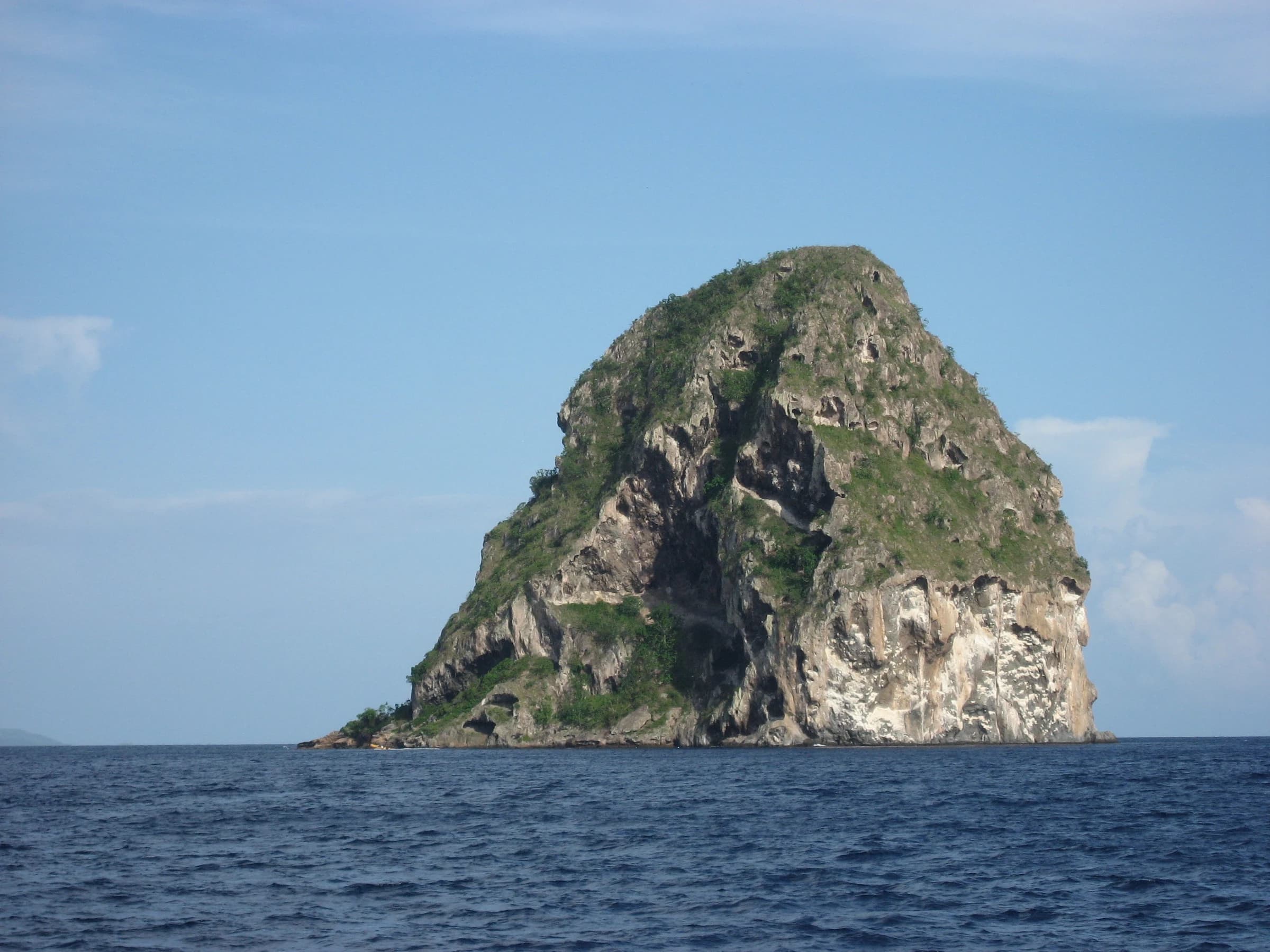
Off Grande Anse du Diamant, about 25 km northwest of Le Marin, Diamond Rock is an uninhabited basalt islet 175 metres high and 5.3 hectares in area. Its name is said to come from the reflections its sides cast at certain times of day, evoking the sparkle of a precious stone. Its place in naval history is unique: in February 1804, British Commodore Sir Samuel Hood had it armed and officially commissioned it as a Royal Navy "stone frigate" under the name HMS Diamond Rock, with two lieutenants and 120 men under Lieutenant James Wilkes Maurice. Two 18-pounder guns were hauled to the summit, backed by 24-pounder batteries at the base and in a cave halfway up. For 17 months this garrison disrupted French shipping to Fort-de-France by controlling the Saint Lucia Channel. A Franco-Spanish force under Captain Cosmao-Kerjulien attacked between 16 and 29 May 1805; the decisive assault on 31 May left the British, out of water after their cistern cracked in an earth tremor and nearly out of ammunition, to surrender on 3 June 1805 after resisting two 74-gun ships, a frigate, a corvette, a schooner and eleven gunboats. The British briefly retook the rock in 1809 before it reverted to France for good under the 1815 settlement. Today an ecological sanctuary recognised as an Important Bird Area (brown boobies, brown noddies, bridled terns), the rock also holds a triangular cave popular with divers, where a cannon toppled by the French from the summit is said to have been found. Currents are strong and diving there is reserved for experienced divers.
Culture & HeritageAll year round
Diamond Rock, the "stone frigate"
A 175-metre volcanic islet off Le Diamant, famous for having been commissioned as a Royal Navy warship in 1804.